Monday, November 19, 2012

The Language of the Fan


 by Susanne Dietze


"Men have the sword, women have the fan and the fan is probably as effective a weapon!" --Joseph Addison

Cleopatra's slaves used them to keep her comfortable as she sailed on her barge. The Chinese associated them with mythical characters. The folding variety we all recognize originated in Japan, but China became famous for them. Once they arrived in Europe around 1550 with traders from the far east, they became a plaything of the nobility. Nowadays, I seldom see them, except on warm summer Sunday mornings when a woman inevitably puts one to use during church services.


Fans have come a long way, baby.


As a historical writer, fans are an essential accessory to my female characters. (And through the post I'm sticking to European--primarily British--fans.) I knew they were used for flirtatious purposes, and I knew they were beautiful, but who knew they had their own language?

Lady Holding a Fan by Francesco Bartolozzi
First, a bit of background. Fans became an essential accessory for well-bred females, and they no doubt own different fans for mourning and various types of social events. In the early 1600s, fans were often "fixed," or made of feathers attached to a handle: they did not fold. By the end of the century and into the eighteenth century, folded fans had come into their own, and it appears that if a lady used a fixed fan, she labeled herself as not at all up on things. Or common. Tsk tsk.

Folding fans seem to have come in three types: the plain old folding type (yes, the name sounds obvious) is where a set of sticks is fastened together at one end and pleated material (silk, leather, or other fabric) is fastened to the sticks. (Feathers and lace, by the way, went in and out of fashion.)
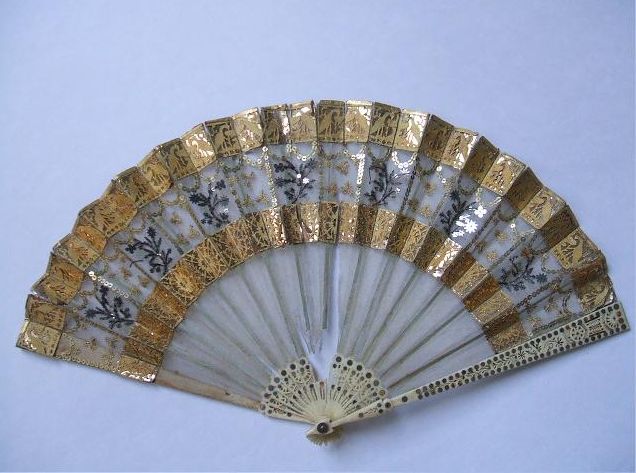
Public Domain


Ladies also used cockade fans, which are pleated paper attached to two sticks. They open into a full circle with the end sticks forming a handle--although I have not seen them in portraits or read of ladies using them at balls. However, I am not an expert. Just passing along the info.
Courtesy of York Museums Trust
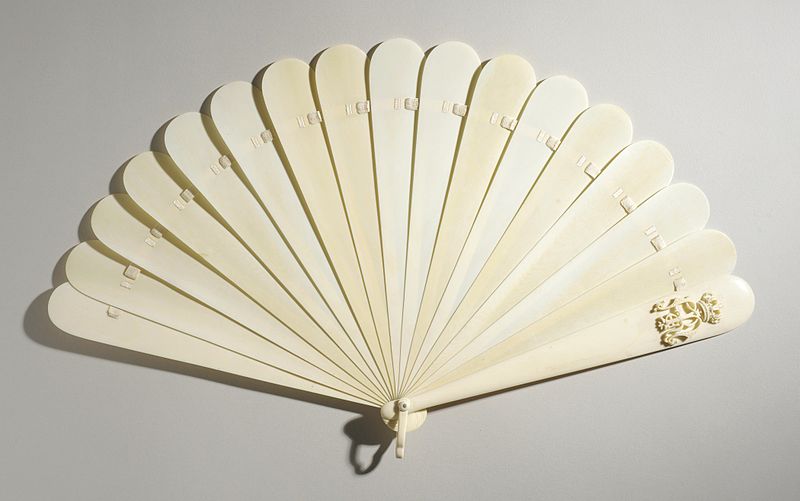
There were also brisé fans, where separate sticks are fastened together at one end like the folding fan, but they did not use fabric or leather. Rather, the sticks were painted individually to create a scene or were ornamental, and were often held together at the top with a ribbon. It was much harder to paint on these fans than a folding fan.

File:Brise Fan with Box LACMA M.85.85.19a-b (1 of 2).jpg
Public domain, courtesy of LACMA


Painted fans were certainly popular, and often depicted pastoral, Asian, mythological, or Biblical scenes. In the eighteenth-century through the Regency period, Vernis Martin fans were valued. Vernis (French for varnish) was a technique developed by the Martin brothers, who hand-painted the scenes. This Vernis Martin Fan had mother-of-pearl guards.

Apparently, ladies painted images on their own fans, too: Princess Augusta, aunt of Queen Victoria, painted one that now belongs to her Majesty, Queen Elizabeth II. According to documentation, it was created around 1790 and the medallions painted on the panels were done by "one of George III's daughters."

Here enters the so-called Language of the Fan.The fan was no longer a pretty frippery, or a cooling device, but also a method to convey secret codes.

The notion probably began as an advertising technique by fan-makers, but Fan Languages were published in contemporary magazines and books on etiquette. Charles Francis Badini wrote a book called Fanology or Ladies’ Conversation Fan, which was published in 1797. It listed many gestures along with the secret codes they conveyed, including: 

Carrying Open fan: come speak with me
Twirling the fan in the right hand: I love another
Twirling the fan in the left hand: We are being watched
Placing the fan near your heart: I love you
A half-closed fan pressed to the lips: You may kiss me
Letting the fan rest on the right cheek: Yes
Letting the fan rest on the left cheek: No
Dropping the fan: We will be friends

Other sources decoding fan language offer some pretty specific statements:

Placing fan on left ear: I wish to be rid of you
Carrying fan in right hand in front of face: Follow me
Drawing fan across the forehead: You have changed
Drawing fan through the hand: I hate you
Threaten with shut fan: You are imprudent
Gazing at shut fan: Why do you misunderstand me?

Perhaps he misunderstands because this gets so complicated, m'dear. While many a female no doubt practiced these motions before the looking glass, one wonders how many gentlemen scratched their bewigged heads in utter cluelessness. Also, how many matchmaking mamas were so oblivious that they wouldn't understand what it meant when her daughter threatened a suitor with a shut fan?

The Language of the Fan seems to fallen out of vogue for a generation: the Regency. Fans were still an essential accessory, however. This Regency lady is ready for a magical evening at Lord and Lady Fabulous' ball. She is wearing her gown of pink crepe, a toque on her head, elbow-length kid gloves, her satin slippers, and carries--of course, her fan. She may not use it to send secret codes, but no fashion-minded, status-conscious British lady of the 18th and 19th century would attend a ball without one.

Rolinda Sharples' painting, Cloak Room, Clifton Assembly Room, was painted in 1817. Look at all these Regency ladies holding their fans! It might be difficult to view, but many of the fans appear to be white or sheer.
Cloak Room, Clifton Assembly Room, 1817, Rolinda Sharples

The Victorians took fans to a whole different level. French maisons created fans for the very wealthy. Tablitiers carved exquisite sticks, and famous artists painted (and signed) fans. As the language of flowers became popular again, no doubt the language of the fan refreshed, as well.

"The Political Lady" by James Tissot, 1884. Get a load of her feather fan! And gorgeous gown...
Alas, fans as a fashion statement seem to have gone the way of the elbow-length glove and the bonnet. So for now, my experience with gorgeous fans will have to be limited to my imagination, when my characters use them to their advantage.

But to you, I will drop my fan. (Translation: we will be friends. Although that totally isn't what it sounds like to me.)


Susanne Dietze began writing love stories in high school, casting her friends in the starring roles. Today, she writes in the hope that her historical romances will encourage and entertain others to the glory of God. Married to a pastor and the mom of two, Susanne loves fancy-schmancy tea parties, travel, and curling up on the couch with a costume drama and a plate of nachos. She won first place in the Historical category of the 2011-2012 Phoenix Rattler, and her work has finaled in the Genesis, Gotcha!, and Touched By Love Contests. Susanne is represented by Tamela Hancock Murray of The Steve Laube Agency. You can visit her on her website, www.susannedietze.com.


Friday, November 16, 2012

Texas Trails, A Morgan Family Series

by Anita Mae Draper


Last year, Moody Publishers caught my attention when they introduced the River North fiction line with a lineup that included Texas Trails, A Morgan Family series.

They describe Texas Trails as “…a six-book series about four generations of the Morgan family living, fighting, and thriving amidst a turbulent Texas history spanning from 1845 to 1896. Although a series, each book can be read on its own.”

I really enjoyed these books since the first one came out last year. Now that all the books in the series have been released and some are showing up on sale at on-line bookstores, I thought I'd tell you about them and not just what I thought about them. Following is the book cover and blurb for each book in the Texas Trails series.


Book 1: Lone Star Trail by Darlene Franklin


Judson (Jud) Morgan's father died for Texas' freedom during the war for independence. So when the Society for the Protection of German Immigrants in Texas (the Verein) attempts to colonize a New Germany in his country, he takes a stand against them.

After Wande Fleischers' fiancée marries someone else, the young fraulein determines to make new life for herself in Texas. With the help of Jud's sister Marion, Wande learns English and becomes a trusted friend to the entire Morgan family.

As much as Jud dislikes the German invasion, he can't help admiring Wande. She is sweet and cheerful as she serves the Lord and all those around her. Can the rancher put aside his prejudice to forge a new future? Through Jud and Wande, we learn the powerful lessons of forgiveness and reconciliation among a diverse community of believers.


Book 2: Captive Trail by Susan Page Davis

 
Taabe Waipu has run away from her Comanche village and is fleeing south in Texas on a horse she stole from a dowry left outside her family's teepee. The horse has an accident and she is left on foot, injured and exhausted. She staggers onto a road near Fort Chadbourne and collapses.

On one of the first runs through Texas, Butterfield Overland Mail Company driver Ned Bright carries two Ursuline nuns returning to their mission station. They come across a woman who is nearly dead from exposure and dehydration and take her to the mission.

With some detective work, Ned discovers Taabe Waipu identity. He plans to unite her with her family, but the Comanche have other ideas, and the two end up defending the mission station. Through Taabe and Ned we learn the true meaning of healing and restoration amid seemingly powerless situations.


Book 3: Long Trail Home by Vickie McDonough

When Riley Morgan returns home after fighting in the War Between the States, he is excited to see his parents and fiancee again. But he soon learns that his parents are gone and the woman he loved is married.

Riley takes a job at the Wilcox School for the blind just to get by. He keeps his heart closed off but a pretty blind woman, Annie, threatens to steal it.

Through painful circumstances, Riley and Annie learn that the loving and sovereign hand of God cannot be thwarted.


Book 4: A Ranger's Trail by Darlene Franklin

In 1875 Buck Morgan rode into Mason County with the Texas Rangers to quell the violence stirred up by the actions a vigilantly mob. The Hoo Doo (or bad luck) War erupted as suspected cattle rustlers were murdered by an angry mob. Former ranger, Scott Cooley, gathers a gang to seek vengeance for the murders.

Suspected of cattle rustling, Leta Derrick's husband was murdered by the mob a year earlier. Now she is siding with the rogue ranger, Scott Cooley and refuses to help Buck Morgan stem the tide of violence.

Will their actions fuel the fire of vengeance? Or will Buck and Leta strike an accord that leads to more than just peace?


Book 5: Cowgirl Trail Susan Page Davis

In 1884 Maggie Porter returns to the Rocking P Ranch. The sanatorium was not able to save her mother and now her father's health is failing. When the cowboys walk off the job leaving no one to drive the cattle to market, head ranch hand, Alex Bright, cannot convince the men to stay. How could Alex let this happen?

Maggie is desperate to save the ranch and she turns to the town's women for help. The new cowgirls must herd, rope, and drive the cattle to market. With only two days left, outlaws charge the small band of cowgirls in an effort to start a stampede. The cattle begin to scatter. Will they lose everything? Where will their help come from?


Book 6: End of the Trail by Vickie McDonough

In 1896 Brooks pulls into the town of Shoofly to take refuge from a storm and befriends John Langston in the local cafe. A high stakes poker game ends with Brooks holding the deed to John’s ranch with one condition – Brooks must promise to take care of Keri. Brooks agrees and assumes that Keri is a horse.

Overcome by guilt, Brooks return to the cafe to give back the deed but finds John on the floor dead. Brooks heads off to take care of John’s ranch and is ambushed. With a noose around his neck, hands tied behind his back he offers a prayer up to God.

A stunning shot breaks the rope and frees Brooks. The bullet is delivered from the rifle of a lady on horseback. But the lady is Brooks’ enemy too. Will she and Brooks put aside their differences and work together?

~~~~~~~~~~~


If you're looking for reading enjoyment in a historical western series with a variety of stories based on 19th century western life, then this is an very good choice. The accomplished authors know their material and craft.

I liked how the origin of the morgan horse breed was incorporated into the series.

Some readers may find the 'girl power' in Cowgirl Trail hard to take in, but in my own research, I've read several books and articles on women who did a man's job because it needed to be done and there was no one else to do it. And I really liked the way it was done in this story. Refreshing.

To learn more about the Texas Trails series (including a family tree and a detailed map!), visit www.texastrailsfiction.com.

The River North Fiction blog has more information on these books including author interviews and interesting research facts. I couldn't find a category or label list, but there is a search box at the top of the page. Type in the title of the book you're interested in and all the pertinent posts will appear.

Here's a recap if you want the titles together for when you go shopping:

The Texas Trail Series
Book 1: Lone Star Trail by Darlene Franklin
Book 2: Captive Trail by Susan Page Davis
Book 3: Long Trail Home by Vickie McDonough
Book 4: A Ranger's Trail by Darlene Franklin
Book 5: Cowgirl Trail Susan Page Davis
Book 6: End of the Trail by Vickie McDonough

And finally, if you want an example of what to expect, here's a quote I 'lifted' from one of Vicky McDonough's posts on the River North blog...


Have you read any books in the Texas Trails series, or from River North? What did you think?


~~~~~~~~~~~~~~~~~~~~~~~~~~~~~~

Anita Mae Draper is retired from the Canadian Armed Forces and lives on the prairie of southeast Saskatchewan, Canada with her hubby of 30 plus years and 2 of their 4 kids. She writes stories set on the prairies of Saskatchewan, North Dakota, Montana and Wyoming. Anita Mae has semi-finaled in the Historical Romance category of the ACFW's 2011 Genesis contest and finaled in the Inspirational category of the 2011 Daphne du Maurier, the 2011 Fool for Love, the 2011 Duel on the Delta and 2009 Linda Howard Award of Excellence contests. Anita Mae is represented by Mary Keeley of Books & Such Literary Agency. You can find Anita at http://www.anitamaedraper.com/

Thursday, November 15, 2012

Paul’s Thorn in the Flesh – An Interactive Discussion

by Dina Sleiman

Well, The Message Version of the Bible has done it again. It’s made me look at a scripture with whole new eyes. It’s brought new light to something I thought I understood, and made me realize how much I’d missed. This time it's II Corinthians 12:7-10. Most of you will know this passage as the famous one about Paul’s “thorn in the flesh.” Paul had pride, so he was given some sort of thorn in the flesh. Okay, I guess that makes sense, kind of.


But the Message Version drives it to a new level that sort of blows my mind. “I was given the gift of a handicap to keep me in constant touch with my limitations.” That makes more sense to me than a "thorn in the flesh."And I had never thought of a handicap as a “gift.” That sort of flies in the face of the theology I was taught growing up. Who is this gift from? We know that God only gives good and perfect gifts, so there must be something I’m not understanding here.
But wait!!! Now it says here that “Satan’s angels did their best to get me down.” So is this handicap a gift, or a curse from Satan. Now I’m really confused?
But what this thing--this handicap, gift or not--ended up accomplishing was certainly good. “What he in fact did was push me to my knees.” Maybe what I need to do is stop trying to figure out where this thing came from. It seems like whether it’s good or bad, blessing or curse, has more to do with the response of the recipient. In Paul’s case, it drove him to his knees, brought him closer to God, which is a good thing. “No danger then of walking around high and mighty!” So it caused him to be humble and rely on God, which is also good.
Paul goes on to say at first he didn’t see it as a gift (no wonder I’m confused), and he asked three times for God to take it away from him. Boy do I relate. I have things I’ve asked God to remove from me. You’d think he’d want to do that. It would make my life easier, and make it easier for me to be good and keep his commands and accomplish things for his kingdom. But God’s ways aren’t always my ways. Instead he says, “My grace is enough; it’s all you need. My strength comes into its own in your weakness.”
Then Paul continues, “Once I heard that, I was glad to let it happen. I quit focusing on the handicap and began appreciating the gift. It was a case of Christ’s strength moving in on my weakness. Now I take limitations in stride, and with good cheer, these limitations that cut me down to size—abuse, accidents, opposition, bad breaks. I just let Christ take over! And so the weaker I get, the stronger I become.”

That leaves me with a number of questions:
-Why does God do this?
-What was Paul’s thorn in the flesh?
-Was it a physical handicap or something more spiritual or emotional?
-At the end of the day, is it a gift from God, or is he just turning something bad for his good?
-What am I supposed to be learning in all of this?
-I understand that I can’t do much about accidents and bad breaks, but what about abuse? In Paul’s society he was being abused by the government, but what about my society in which abuse is illegal? In which I have rights and recourses against opposition?

I’d love to chat with you throughout the day. Take a look at this scripture and let me know what you think ~~~~~~~~~~~~~~~~~~~~~~~

Dina Sleiman writes lyrical stories that dance with light. Most of the time you will find this Virginia Beach resident reading, biking, dancing, or hanging out with her husband and three children, preferably at the oceanfront. Since finishing her Professional Writing MA in 1994, she has enjoyed many opportunities to teach literature, writing, and the arts. She was the Overall Winner in the 2009 Touched by Love contest for unpublished authors. Her debut novel, Dance of the Dandelion with Whitefire Publishing, won an honorable mention in the 2012 Selah Awards. Her latest novel, Love in Three-Quarter Time, is the launch title for the new Zondervan First imprint. Dina is a contributing author at Inkwell Inspirations, Colonial Quills, iflourishonline.com, a part-time acquistions editor for WhiteFire Publishing, and she is represented by Tamela Hancock Murray of The Steve Laube Agency. Join her as she discovers the unforced rhythms of grace. For more info visit her athttp://dinasleiman.com/

Share This Post

How Our Giveaways Work: The Official Rules

We, the ladies of Inkwell Inspirations, would love to give free stuff to everybody. Since we can't, we will often have a giveaway in conjunction with a specific post. Unless otherwise stated, one winner will be drawn from comments left on that post between the date it was published and the end of the giveaway as determined in the post. Entries must be accompanied by a valid email address. This address is used only to contact the commenter in the event that he/she is the winner, and will not be sold, distributed, or used in any other fashion. The odds of winning depend on the number of entrants. NO PURCHASE, PLEDGE, OR DONATION NECESSARY TO ENTER OR TO WIN. ALL FEDERAL, STATE, LOCAL AND MUNICIPAL LAWS AND REGULATIONS APPLY. VOID WHERE PROHIBITED.

Pinterest