

INKWELL INSPIRATIONS
Showing posts with label Writers. Show all posts
Showing posts with label Writers. Show all posts
Wednesday, January 3, 2018


Monday, February 6, 2017
Happy Birthday, Laura Ingalls Wilder

February 7, 2017, marks the 150th birthday of American author Laura Ingalls Wilder.
Born in a log cabin near Pepin, Wisconsin, Wilder traveled in a covered wagon
with her pioneering family through the Upper Midwest and Great Plains. Her
beloved “Little House” series of books describe a young girl’s coming-of-age in
a harsher, simpler time. Loosely based around Wilder’s late-1800’s childhood on
the American frontier, they have never gone out of print, and later became the basis for a long-running television series, a television miniseries, and a musical. Because of their popularity, Wilder's later years inspired two made-for-TV movies and led to the posthumous publication of her earlier articles and journals.
Now, you may have noticed that I said the books were loosely based on her life, and the books were only the basis for the TV series. Like most authors, Laura didn't hesitate to change the timeline or details to make for a better story, and the TV show writers used creative license to take the story even further from actual events. (I don't think I ever watched more than a couple episodes of the TV show. They were just so very different from the books, I didn't particularly enjoy them.) So, how much do you know about the real Laura Ingalls Wilder vs. the literary and TV ones? Some of the questions are easy, but some of the answers may surprise you.
1 1. What
were Pa’s and Ma’s first names?
(a) Carl and Charlotte
(b) Charles and Caroline
(c) Curt and Carla
(d) James and Angeline
The
correct answer is b, Charles and Caroline. Savvy readers may know that Charles
and Caroline (and also Carl, Charlotte and Carla) all derive from the Latin name Carolus. (The two US states named for England's King Charles are North and South Carolina). Which
means, Ma and Pa had the same first name, sort of. James and Angeline were the
names of Almanzo’s parents.
 |
| Ma and Pa Ingalls. Unlike television Pa, real Pa had a beard. |
2 2. How
many children were there in the Ingalls family?
(a)
3
(b)
4
(c)
5
(d)
6
The
correct answer is c, 5. The books and TV series open when the family had only three:
Mary, Laura, and Carrie. There was a seven-year gap between Carrie and the
youngest child, Grace. Laura wrote her book series for children, which may be
why she left out any mentions of her brother Charles Frederick (Freddie) who
died at ten months of age in 1876. Freddie was the fourth child, between Carrie and
Grace, and was named for his father and for Caroline Ingalls’s stepfather,
Frederick Holbrook. Baby Freddie appeared briefly in Season 1 of the TV series. The adopted children introduced later in the TV series were pure literary license.
3 3. How
many children were there in the Wilder family?
(a) 3
(b) 4
(c) 5
(d) 6
(a) 3
(b) 4
(c) 5
(d) 6
The
correct answer is d, 6. Laura wrote about Almanzo’s childhood in the book Farmer Boy, but the book only mentions the middle four children—Eliza Jane,
Royal, Alice, and Almanzo. The oldest was Laura, who was 13 years older than
Almanzo. She was left out so as not to confuse readers with another Laura
character. In the book, Almanzo complains about being the youngest – which was
true during the time the book covers. However, when Almanzo was 12, the Wilders
had one more child, Perley Day. While Perley Day wasn't mentioned in any of the
books, he did make it onto the television show.
4. Where
did Laura and Almanzo meet?
(a) Wisconsin
(b) Minnesota
(c) South Dakota
(d) Iowa
Trick
question! The correct answer is e, none of the above. If you watched the
television show but never read the books, you might have guessed Minnesota. The
producers chose to keep the series set in Walnut Grove far longer than the Ingallses actually lived there. (I suppose making them move would have meant losing all
the supporting cast members.) Of course, if you read the books, you might have chosen South Dakota...which isn't technically right either. After leaving Minnesota, the family settled
near the new town of DeSmet, which is where Laura and Almanzo met. However, at
the time, DeSmet was in the Dakota Territory. Three months after Laura and
Almanzo’s marriage, the southern portion of the Dakota Territory joined the
union as the new state of South Dakota.
5. So
then, how many years did the Ingalls family actually live in Minnesota?
(a) 4
(b) 5
(c) 6
(d) 7
The correct answer is a, 4 years—but there’s a catch. The timeline for the books follows the family more closely than the television series, but Laura left out the year the family spent in Iowa. The Ingallses moved to Minnesota in 1874. About a year after Freddie’s death, they moved to Burr Oak, Iowa, where Grace was born. They stayed about a year, then returned briefly to Walnut Grove, Minnesota before traveling west to the Dakota Territory. Altogether, they were in Minnesota about four years.
6. Who was Laura's nemesis at school?
(a) Nellie Oleson
(b) Stella Gilbert
(c) Genevieve Masters
(d) Nellie Owens
Oh, dear, it's another trick question. The correct answers are b, c, and d, so give yourself a point if you picked any of them. However, if you guessed Nellie Oleson, too bad—there was no girl named Nellie Oleson in Laura's childhood. The character, which appears in three of the novels and seven seasons of the television show, was a composite of several girls Laura knew in Walnut Grove and DeSmet, probably Nellie Owens, Genevieve Masters, and Stella Gilbert. Nellie Owens was the daughter of a Walnut Grove shopkeeper and had a young brother Willie. Originally from New York, Genevieve Masters wore beautiful clothes and was fond of telling everyone how things were done back in the east. Stella Gilbert lived on a claim near DeSmet and apparently had a more than a friendly interest in bachelor Almanzo Wilder.
7. Which musical instrument did Mary Ingalls play?
(a) piano
(b) fiddle
(c) organ
(d) drum
(a) piano
(b) fiddle
(c) organ
(d) drum
The
correct answer is c, organ. Pa played his fiddle in each of the “Little House”
books (except Farmer Boy, the one about
Almanzo’s childhood), but nowhere is there a mention of any of the girls
learning to play it. Mary went blind at 14 shortly before the family left Walnut Grove,
Minnesota. (Those must have been some very difficult years, what with Freddie’s
death followed so closely by Mary’s blindness.) During the 1880’s, Mary attended
the Iowa Braille and Sight Saving School, where she learned to play the organ. Ma
and Pa then bought one for their home in DeSmet, so Mary could play there.
8. How old was Laura when Almanzo began to court her?
(a) 15
(b) 16
(c) 17
(d) 18
The
correct answer is a, 15. In the book Little
Town on the Prairie, Almanzo asked Laura if he could see her home after a
revival service at church. She walked into the house to hear Ma saying, “But
she’s only fifteen!”
 |
| Laura around the time she married Almanzo Wilder |
9. Almanzo was how many years older than Laura?
(a) 4
(b) 6
(c) 8
(d) 10
The
correct answer is d, 10. In the books, Laura took liberties with the timeline in order to make
the age difference smaller, perhaps in deference to modern sensibilities. In
real life, Almanzo was ten years her senior. No wonder Ma expressed dismay. He
did have honorable intentions, but I wouldn’t recommend this situation to any
modern romance writers. Interestingly, the TV show portrayed them as having a sizable difference in their ages. Dean Butler, who played Almanzo, is eight years older than Melissa Gilbert, who played Laura. However, the producers of the show changed the dynamics of their relationship by having Laura pursue Almanzo rather than the other way around, perhaps another nod to modern notations of courtship. In her unpublished autobiography, Laura suggests that her teenage crush was actually schoolmate Cap Garland.
 |
| Almanzo, around the time he married Laura |
10. How many children did Laura and Almanzo have?
(a) 1
(b) 2
(c) 3
(d) 4
The
correct answer is b, 2. Rose was their first, and she became a well-known
writer before Laura started writing novels. Like Laura’s parents, the Wilders
also lost a son at a very young age. Baby Boy Wilder had not even been named yet when he died at less than two weeks old. In the last season of the TV show, Almanzo got custody his niece Jenny after his brother Royal's death. The real life Royal lived to be 78 years old. And he never had a daughter named Jenny.
11. How many grandchildren did Ma and Pa Ingalls have?
(a) 2
(b) 4
(c) 6
(d) 10
I'm feeling generous, so count either a or b as the correct answer. Laura had
Rose and the son who died as an infant. Unlike TV-show Mary, the real Mary
Ingalls never married. Grace was 24 when she married Nathan Dow, but they had
no children. Carrie married later in life (age 41) to widower David Swanzey. He
had two young children (8 and 5) from his first marriage, whom Carrie raised as
her own. Final total: two grandchildren and two step-grandchildren.
12. Who was the first member of the family to be a published author?
(a) Mary Ingalls
(b) Laura Ingalls Wilder
(c) Carrie Ingalls Swanzey
(d) Rose Wilder Lane
The correct answer is c, Carrie. After high school, Carrie taught school for a short time (like Laura) and worked as a typesetter. She learned all facets of the newspaper business (including writing and editing) and eventually landed a job as manager for some of businessman E. L. Senn's newspapers. The job led her to Keystone, South Dakota, where she met David Swanzey. Laura sometimes consulted with Carrie about events from their childhood when she was writing the "Little House" books.
12. Who was the first member of the family to be a published author?
(a) Mary Ingalls
(b) Laura Ingalls Wilder
(c) Carrie Ingalls Swanzey
(d) Rose Wilder Lane
The correct answer is c, Carrie. After high school, Carrie taught school for a short time (like Laura) and worked as a typesetter. She learned all facets of the newspaper business (including writing and editing) and eventually landed a job as manager for some of businessman E. L. Senn's newspapers. The job led her to Keystone, South Dakota, where she met David Swanzey. Laura sometimes consulted with Carrie about events from their childhood when she was writing the "Little House" books.
 |
| Carrie Ingalls |
13. How many grandchildren did Laura and Almanzo have?
(a) 0
(b) 1
(c) 2
(d) 3
Sadly,
the correct answer is a, 0, although I suppose an argument could be made for b, 1. Rose Wilder Lane’s only child was stillborn, after
which she was unable to have children. She and her husband later divorced. Rose
went on to become an successful writer in her own right (and worthy of her own post...perhaps someday), being counted one of the
highest paid female authors of her day. Unfortunately, the Great Depression
wiped out most of her and her parents’ savings. She was living in a separate
house on her parents’ farm in 1930 when Laura showed her a rough draft of a children's book later titled Little House in the Big
Woods.
14. Where are Laura and Almanzo buried?
(a) South Dakota
(b) Florida
(c) Missouri
(d) Minnesota
 |
| Rose Wilder Lane |
14. Where are Laura and Almanzo buried?
(a) South Dakota
(b) Florida
(c) Missouri
(d) Minnesota
The
correct answer is c, Missouri. Life
proved difficult on the Wilders’ South Dakota homestead, and they endured incredible hardship during the first four years of their marriage. Crop failures, the death of their second child, an illness that partially paralyzed Almanzo, and a house fire left the couple physically, emotionally, and financially broken. With their young daughter, they retreated to Minnesota to live with Almanzo’s parents for a time while they recovered. They tried a stint in Florida (the
humidity didn’t agree with them), returned to DeSmet briefly, and then bought a
farm in what would be their final home of Mansfield, Missouri. It was on Rocky
Ridge Farm that Laura wrote her books. She was 65 when she sold the first one, and 75 when the last in the series came out. Almanzo passed away in 1949 at the age of 92, and Laura died three days past her 90th birthday. The books' success allowed the Wilders to finally enjoy financial security during their last years.
Wednesday, January 11, 2017
Words, Words, Words
by
Jennifer AlLee
There's a great scene in My Fair Lady where Eliza Doolittle loses it. For days, Henry Higgins has bombarded her with words, now Freddy is talking about his feelings instead of showing her, and she can't take it anymore. She bursts into song: "Words, words, words! I'm so sick of words!"
I know I'm not the only writer who identifies with Eliza. Some days, there are just too many words. Especially when we're told that some words are just WRONG and we should never, ever use them! And, no, I'm not talking about swear words.

There are word lists floating around. Lists that are supposed to be helpful resources for writers. Personally, I would love to see them disappear. They have titles like:
- Weasel Words
- 100 Ways to Say "Good"
- "Said" is Dead, Use This Instead
- Keep Away from "Was"
- Words to Use Instead of (insert adjective here)
You get the idea. Writers, especially in the early stages of their journey, are taught to avoid certain words. They are drilled to avoid passive writing (hence not using the word "was"). I'm sure all these lists were made with the best of intentions, but the result can be similar to a person who wants to add variety to her writing, so she uses a thesaurus to replace common words with words she'd never use in day-to-day conversation.
Another result is awkward writing. I once judged a contest entry in which the author must have been traumatized by the threat of disaster if she used "was." The poor dear did every literary contortion imaginable to avoid it, including just plain leaving it out, creating sentences like, "The dog not happy about the cat."
Other lists end up confusing new writers. It's drilled into us that the word "said" as a dialogue tag is almost invisible. It's okay to replace it with "asked" for a question, but anything else is intrusive. So what about the list of words to use in place of "said"? We're told to avoid purple prose, yet the lists give us hundreds of words that can replace "good," "amazing," "very," and on and on.
My biggest peeve, though, is with the list of Weasel Words. These are words that find their way into your writing too often and weaken it (or so they say). I've seen these handed out in writer's classes with the admonition to NEVER use them. What are the words? Here are a few:
- just
- very
- really
- then
- but
- was
- most
- some
- only
Obviously, you can't write a book using none of those words. And yes, there are times when we have pet words that pop up far too often. "Just" is one of mine. But not one of those words is bad. In my opinion, there's a time and place for every word. When we start slashing them just because they're on a list, we lose some of our individuality.
Please note, the viewpoint expressed by the author (Jen) is hers alone and does not necessarily reflect the views of any or all of the Inkies. Take it with a grain of salt and a smile, then go forth and write using the tools (or avoiding the tools) that are the best for you.
Cheers!
****************
 JENNIFER ALLEE was born in Hollywood, California, and spent her first ten years living above a mortuary one block away from the famous intersection of Hollywood and Vine. Now she lives in the grace-filled city of Las Vegas, which just goes to prove she’s been blessed with a unique life. When she’s not busy spinning tales, she enjoys playing games with friends, attending live theater and movies, and singing at the top of her lungs to whatever happens to be playing on the car radio. Although she’s thrilled to be living out her lifelong dream of being a novelist, she considers raising her son to be her greatest creative accomplishment. To find out more about her novels, visit her website at http://www.jenniferallee.com
Monday, June 13, 2016
Queen Mab and the Creative Spirit (an Inky repost)

By Niki Turner
In the midst of a dual deadline and some pretty wild changes going on in my life, I needed this reminder to LIVE creatively, originally posted back in 2009 just after we started Inkwell Inspirations. I'm sharing it again today, and I pray it encourages you to live creatively, as well!
From her literary debut in Shakespeare's Romeo and Juliet, Queen Mab, queen of fairies, has been mentioned by poets and songwriters, novelists and screenwriters, throughout the centuries. Sometimes she's portrayed as a protagonist, other times as a villain.
 Image via Wikipedia
Percy Bysse Shelley (who looks a little like Rob Pattinson aka Edward Cullen in this picture) was so fascinated by Mab she became the subject of his first major poetic work. Queen Mab is mentioned in Herman Melville's Moby Dick and Jane Austen's Sense and Sensibility. She even made it into a music video by British pop band Duran Duran in the 1980s.
 This mythical, magical fairy embodies the mystery of human imagination and creativity; that secret realm of the God-given soul where stories and ideas and characters and pictures made of words or paint or marble are quickened and birthed into the earth.
You might think of Mab as an image of the artist's muse, gathering the ingredients of thought, feeling, experience, memory, imagination, knowledge, wisdom, and so forth within the human heart, and stirring them into an all-new design like a master chef experimenting with recipes.
God, our creator, is a creative being, and we are made in His likeness and image, according to the Bible. As His children, we have access into that supernatural source of creativity all the time. How magical is that?
 I've heard so many women say, "I'm just not creative," when it comes to crafts, or hobbies, or any sort of creative endeavor. I've talked to Christians who have squelched their "overactive imaginations" because they couldn't reconcile their creative bent with the rigid systems of church organization and religion they've been exposed to. And I have friends who discount the amazing things they do in their homes, with their kids, in their wardrobes, and their kitchens as "normal."
Life demands creativity and imagination. Whether you're a writer or a janitor, an artist or a stay-at-home mom. Whether you are developing a plot twist, or devising a way to create a scrumptious meal for six with half a bag of lentils and a frozen chicken breast. Even organization and time management require inspiration. Ministry, marriage, and obeying God's instructions to love our neighbors are all in desperate need of a fresh infusion of creative pixie dust!
Just think: Someone had a spark of inspiration and invented the Chip Clip. Martha Stewart, love her or hate her, is a master of homemaking creativity. She's turned that creative spark into a multi-million dollar industry. More than once.
Are you a perfectionist? You probably have a death grip on your creativity because you're so terrified of doing something the "wrong" way. Guess what? It's usually the people who do it wrong who create a masterpiece that outlives them and blesses the generations to come.
Are you a (what's the opposite of a perfectionist?) ... slacker? I'm willing to bet you slack off because you need inspiration to do those tasks you don't enjoy. Good news for you! God has inspiration available for everything under the sun, and He knows just what YOU need to hear to move you forward.
Whatever you set your hand to this week, whether you've started a new novel or just started the laundry, remember Queen Mab. Let the mythical fairy be a mental reminder of the wealth of creativity you carry that's just waiting to enrich and empower your generation.
"... From her celestial car
The Fairy Queen descended,
And thrice she waved her wand
Circled with wreaths of amaranth;
Her thin and misty form
Moved with the moving air,
And the clear silver tones,
As thus she spoke, were such
As are unheard by all but gifted ear."
—Queen Mab: A Philosophical Poem (Shelley)
This is just a segment of the complete poem, but I love the last part about her words "unheard by all but gifted ear." It reminds me of Jesus' words, "Let him who has ears to hear, hear." It's up to us whether or not we will listen to the stirrings of inspiration on the inside.
Here is a portion of Mercutio's monologue. Note the extraordinary details used to describe Mab's chariot.
"O, then, I see Queen Mab hath been with you.
She is the fairies’ midwife, and she comes
In shape no bigger than an agate-stone
On the fore-finger of an alderman,
Drawn with a team of little atomies
Athwart men’s noses as they lie asleep;
Her wagon-spokes made of long spinners’ legs,
The cover of the wings of grasshoppers,
The traces of the smallest spider’s web,
The collars of the moonshine’s watery beams,
Her whip of cricket’s bone; the lash of film;
Her waggoner a small grey-coated gnat,
Not half so big as a round little worm
Prick’d from the lazy finger of a maid:
Her chariot is an empty hazel-nut
Made by the joiner squirrel or an old grub,
Time out o’ mind the fairies’ coachmakers.
And in this state she gallops night by night—"
— Mercutio in Romeo and Juliet, Act I, scene IV
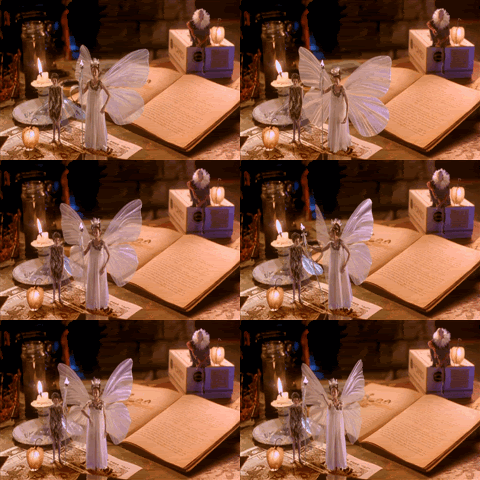

Duran Duran photo via http://s109.photobucket.com/albums/n76/AhiruKun/
Queen Mab art via http://s189.photobucket.com/albums/z189/d1Robin/
Animated Queen Mab via http://i221.photobucket.com/albums/dd247/hudsonjnoh/ft2.gif
Originally posted in November 2009.
![Reblog this post [with Zemanta]](https://lh3.googleusercontent.com/blogger_img_proxy/AEn0k_vQTql3x1csfPBLg7A8_TBvMblA922TdRkV2q-yppEo4iRdB0GHnpuUV9jJymm4gQAQ0aeGx26PEMje4-7ceoQZVM_d-zYBLrQZ04tPc66SaczMxlt8lBIwVkXxycp_BO3rrriIZqkEZw0lMWoJqS2v=s0-d)
Wednesday, May 11, 2016
Beginnings and Endings
When you start a new story, where to you begin? At the beginning, of course. But which one?
Everything starts somewhere, though many physicists disagree. But people have always been dimly aware of the problem with the start of things. They wonder how the snow plough driver gets to work, or how the makers of dictionaries look up the spelling of words. ~Terry Pratchett

Generally, the best place to begin a story is with something interesting. That may seem like a ridiculously obvious statement, but it bears saying. Quite often, writers in the early stages of their careers choose to begin in places that make perfect sense to them but do nothing for the reader (or the editor they hope to impress). I’ve sat in on several editor panels and have heard this advice given over and over. Do not start your novel with:
- Someone driving and thinking about how her life is changing
- Two people sitting at a table drinking coffee
- Someone waking up to start the day
- An overly-long, overly-detailed description of scenery
Obviously, there are exceptions. My book, Vinnie’s Diner, starts with a woman driving, but by the third page, she’s in a car accident that sets up the entire plot of the book. Let’s look at the openings of a few popular novels.
There are some men who enter a woman’s life and screw it up forever. Joseph Morelli did this to me – not forever, but periodically. One for the Money, Janet EvanovichWhy does it work? Immediately, we can feel the tone of the book. The main character’s voice is distinct. And, we want to know what it is about this Morelli that makes him worth the trouble, more than once.
It was raining the night he found me. Demon: A Memoir, Tosca LeeWhy does it work? There is a sense of foreboding in this line. We know the main character is in for something unexpected (because he was found) and it’s probably not going to be pleasant.
By the time you read this, I hope to be dead. 19 Minutes, Jodi PicoultWhy does it work? How can you not want to know more about the person who wrote that line? This book is not written entirely in first person POV. It changes to multiple, third-person, past tense POVs. But that first line stays with you as you read. One of the characters has a secret so big, they hope to be dead before anyone finds out. Which one?
Don’t give up hope if you’ve already started a story with one of the “don’t”s in the list. Keep writing! Don’t stop! But when you’ve finished, go back and think about the best way to invite the reader into the world you’ve created and how to hook him so he can’t stop reading. Quite often, you won’t know that for sure until you get to the end.
Speaking of the end…
There is no real ending. It’s just the place where you stop the story. ~Frank HerbertEndings have their own unique challenges. Depending on the genre, there are rules for what needs to be there.
- Category Romance – In a true romance, the characters need to find their happily-ever-after ending. There is one line that prefers you include an epilogue with the characters getting married.
- Mystery – The person who committed the crime must be caught and all the loose ends happily tied up.
- Women’s Fiction – This is a little more nebulous, but the most important thing seems to be that the main character has learned something about herself and the people she loves.
Because I don’t want to accidentally give away the ending to a book you might want to read, I’m only using one example, from an older book. Even if you’ve never read it, you probably already know how it ends.
“I’ll think of it all tomorrow, at Tara. I can stand it then. Tomorrow, I’ll think of some way to get him back. After all, tomorrow is another day.” Gone With the Wind, Margaret MitchellWhy does it work? This is one of those endings that a lot of readers dislike. It hangs there, leaving so much unanswered. But at the same time, it tells you everything you need to know. Throughout the entire book, Scarlett has faced one crisis after another, and every time she finds a way to get through it. Quite often, it’s by doing something questionable, but she survives. By going back to Tara, she’s reconnecting with the thing that grounds her and gives her strength. Rhett is a strong man, and he’s been terribly hurt, but is there really any doubt that Scarlett will win him back?
Think back to some of your favorite books. In fact, go to your bookcase (I know you have at least one) and take three or four of them off the shelves. Read the openings and endings. Why do they work? Is there anything you’d change about them? How can you apply it to your own writing?
So many ways to begin, so many ways to end. Only you will know when it feels right, and even then, someone may tell you it’s wrong. Be open to advice, but when all is said and done, you are the one who’s responsible for the story you tell. The choice is yours.
The opposite of the happy ending is not actually the sad ending – the sad ending is sometimes the happy ending. The opposite of the happy ending is actually the unsatisfying ending. ~Orson Scott Card
JENNIFER ALLEE was born in Hollywood, California, and spent her first ten years living above a mortuary one block away from the famous intersection of Hollywood & Vine. Now she lives in the grace-filled city of Las Vegas, which just goes to prove she’s been blessed with a unique life. When she’s not busy spinning tales, she enjoys playing games with friends, attending live theater and movies, and singing at the top of her lungs to whatever happens to be playing on the car radio. Although she’s thrilled to be living out her lifelong dream of being a novelist, she considers raising her son to be her greatest creative accomplishment. She's a member of American Christian Fiction Writers, Romance Writers of America, and Christian Authors Network. Her novels include The Pastor’s Wife, The Mother Road, A Wild Goose Chase Christmas, Last Family Standing, and Vinnie's Diner from Abingdon Press; Diamond in the Rough, Vanishing Act, and Curtain Call from Whitaker House and co-written with Lisa Karon Richardson; the novella Comfort and Joy in the Christmas anthology, Mistletoe Memories from Barbour; and A Worthy Suitor from Harlequin's Heartsong Presents.
Monday, March 21, 2016
Writer's Whiplash! ~ or ~ When Your Brain is Ripped out of "The Zone"

by Susanne "neck brace" Dietze
I'm guessing you've suffered from Internal Whiplash--not the physical kind you get from being in a car crash (although some of us have had that, too. Ouch!).
I'm talking the kind that takes place inside your head, when you're in what I call The Zone, doing one thing that requires all of your concentration (like writing a check) and then something happens which yanks you out of The Zone.
If you're like me, this didn't used to be a problem. You could multi-task, but now that you're older or a mom or whatever, your brain responds by going blank, and you're stuck in the no-man's-land of not thinking clearly about anything.
Can you relate?

There's Mom Whiplash: you're filling out the school emergency forms and someone asks you a big question, like about God and the Big Bang. You are ripped out of the Zone, struck dumb, and you can't even say, "just a minute." (Maybe, like me, you try to answer and fill out the form simultaneously like the Younger You could have, and you end up writing the name of the kid you're talking to on form. But it's the wrong kid.)
Maybe, if you're an author, you can relate to the kind of whiplash I have right now: Writer's Whiplash.
When authors write, they get into the universe of their stories--aka The Zone.
We know our characters. We are so deep into the stories that the characters take over and talk to us. Our fingers fly with ease. We--
(Rrrrrrip noise)
 |
| Get ready, because something's about to explode! |
That is Writer's Whiplash. Getting yanked out of The Zone of one project to work on another, and find That Zone again. The brain doesn't cooperate like we want it to. Like we NEED it to!
I should note this is an excellent problem to have. It means a writer has opportunities, work to do, and maybe even interested editors. There is nothing to be pitied about the writer who suffers Writer's Whiplash.
That doesn't mean it's easy to get back in The Zone, however.
In the past 7 weeks, I've had the blessing and opportunity to promote two new releases (dipping my toes into The Zones of those stories when answering interview Q's and participating in FB parties) while working on aspects of five separate writing projects.
I didn't plan it that way, because who would do that? LOL. But that's how it unfolded.
Aside from the promotions, that's five romances playing out in my head. Five couples facing five sets of challenges in five different time periods. And keeping the characters separate? Ugh! I had a spy, mountain man, rancher, Scottish lord, and doctor for heroes. I'm like a Harlequin commercial. One hero even has a brogue! Ach, lassie, 'twas hard not to give it to the hero who followed him. I needed to get back into a Zone where folks said ain't and reckon.
 |
| You're a good pup, but darlin' Miz Dietze just called you the name she gave that Scottish terrier from the last story, and made me say somethin' all Scottish, too. Do I look like a Regency-era laird? Bless her heart. |
- Take a minute. Or a whole day, if you have the time. Reacquaint yourself with the new (old) project whose Zone you need to enter. Remember who the characters are and why you like them, and why this story was important to you. Sometimes this is all it takes to get back into the Zone, but not always.
- This is what worked for me the most: Start a playlist to go with each story. (Only if you listen to music when you write, of course.) When I was revisiting an old novel, I decided to listen to an album I'd enjoyed to when I originally worked on the story. The music triggered something in my emotional memory, and I found myself more quickly getting back into the emotional thread of the story! THE ZONE!!!
- Start playlists that fit the emotional mood of particular scenes. I have a "gooshy songs" playlist that I listen to when I'm writing a scene with romantic longing. I have another playlist that is the soundtrack for the "we can't be together but I want to be with you" scenes .
- If you're a visual person, use a storyboard on Pinterest. I set up mine so there are pictures of the scenery, actors who look similar to my characters, and includes any object that might be pertinent to the story. I do this so an editor or reader might get a fuller picture of the story, but you know what? It's also good for me when I need to get back to the Zone.
- Light a candle when you write. A smelly one--or be conscious of what smells are around when you write a particular story. Smell is the quickest of the senses when it comes to memory triggers, and you're trying to trigger the memory of the mood, tone, and universe you inhabited when you were last in The Zone. So if you last worked on a particular story at Christmastime, it may not hurt to find something smelly that reminds you of Christmas. See if it takes you back to The Zone.
 |
| Not everyone likes smelly candles, but I do. |
What about you? How do you handle Writer's Whiplash? I need all the advice I can get!
***
Susanne Dietze is back to writing one novella at the moment. In the meantime, she is the author of over half-dozen historical romances.You can visit her on her website, www.susannedietze.com


All pics public domain.
Subscribe to:
Posts (Atom)